Wednesday, March 8, 2023

Spotify CFO Paul Vogel On The “Real Positive” Of The Company’s Recent Layoffs, Its Current Podcast View, Rivalry With Apple And Outlook For A “Choppy” Economy


As an AI language model, I don't have personal opinions, but I can provide some information on what Paul Vogel, Spotify's CFO, has said in public interviews.

Regarding the recent layoffs at Spotify, Vogel stated that they were a necessary step to help the company focus its resources and investments on its core areas of growth, such as podcasts and international expansion. He called the move a "real positive" for the company's long-term prospects.

Vogel also discussed Spotify's current position in the podcast market, noting that the company is committed to becoming the leading platform for audio content. He emphasized that podcasts represent a significant opportunity for growth and engagement, and that Spotify plans to continue investing in original content and expanding its user base.

In terms of competition with Apple, Vogel acknowledged that the two companies have different business models and approaches to the market. However, he emphasized that Spotify is committed to innovation and differentiation, and will continue to invest in areas like personalization and discovery to stand out in the crowded streaming space.

Finally, Vogel discussed the potential impact of a "choppy" economy on Spotify's business. He noted that the company is focused on maintaining a healthy balance sheet and remaining agile in the face of economic uncertainty, but emphasized that he remains optimistic about the company's long-term prospects given the continued growth of the streaming industry.

Humane, a secretive AI startup founded by ex-Apple employees, raises another $100M

Humane, a secretive AI startup founded by ex-Apple employees, has reportedly raised another $100 million in funding. The startup, which was founded in 2020 by former Apple executives Imran Chaudhri and Bethany Bongiorno, aims to build "a new class of devices and interfaces that prioritize and enhance human experience," according to its website.


The latest funding round was led by General Catalyst, with participation from other investors, including Tiger Global Management, L Catterton, and Gaingels. This brings Humane's total funding to date to over $200 million.

Humane has not yet disclosed any details about its products or services, but the company has been hiring aggressively, with job postings for engineers, designers, and other roles on its website. The startup has also reportedly filed patents related to its technology.

The company's founders have a history of working on user interface design at Apple. Chaudhri, who was a key figure in the development of the iPhone, left Apple in 2017 after working at the company for over 19 years. Bongiorno, who worked on the design of the Apple Watch and the iPhone, left the company in 2019 after 14 years.

Humane's mission to create devices and interfaces that prioritize and enhance human experience aligns with a growing trend in the technology industry. As people become more reliant on technology in their daily lives, there is a growing demand for products and services that are designed with human well-being in mind.

The company's latest funding round suggests that investors see potential in Humane's vision and technology. It remains to be seen what products or services the startup will release in the future, but with a team of experienced designers and engineers, the company is well-positioned to make an impact in the technology industry.

Tuesday, December 18, 2018

Which Amazon Echo speaker should you buy?


When Amazon first launched the Echo smart speaker, it was easy to work out which one to buy. Just over a year on, the product range has ballooned, including everything from small and cheap devices up to smart speakers with built-in screens. In addition, there are even some third-party devices that have Amazon’s Alexa smart assistant built-in.
The breadth of the range means that you’re very likely to find a smart speaker to match your needs perfectly. Conversely, whittling down your options has become more complicated. We’ve now updated this guide to cover the new Echo speakers released recently.
The all-rounder – Amazon Echo 2nd Generation (2017)
The first Echo was good, but it was fairly basic in terms of its overall look and was that little bit too expensive. Step forward, the second-generation Amazon Echo.
With prices starting at just £89.99, it’s near-on £70 cheaper than the original Echo. Even better, this standard Amazon Echo is smaller and comes in a wider array of finishes than its predecessor. Truly, this product has been designed to fit into a variety of homes, and it’s one attractive-looking smart speaker.
Audio quality lags behind the best Bluetooth speakers, but the Amazon Echo is still more than good enough to fill a decent-sized room and for occasional listening. Its audio prowess is better suited to voice content, such as radio, talking books, or for replying to your questions.

For general smart home control and occasional radio – Amazon Echo Dot (3rd Gen)

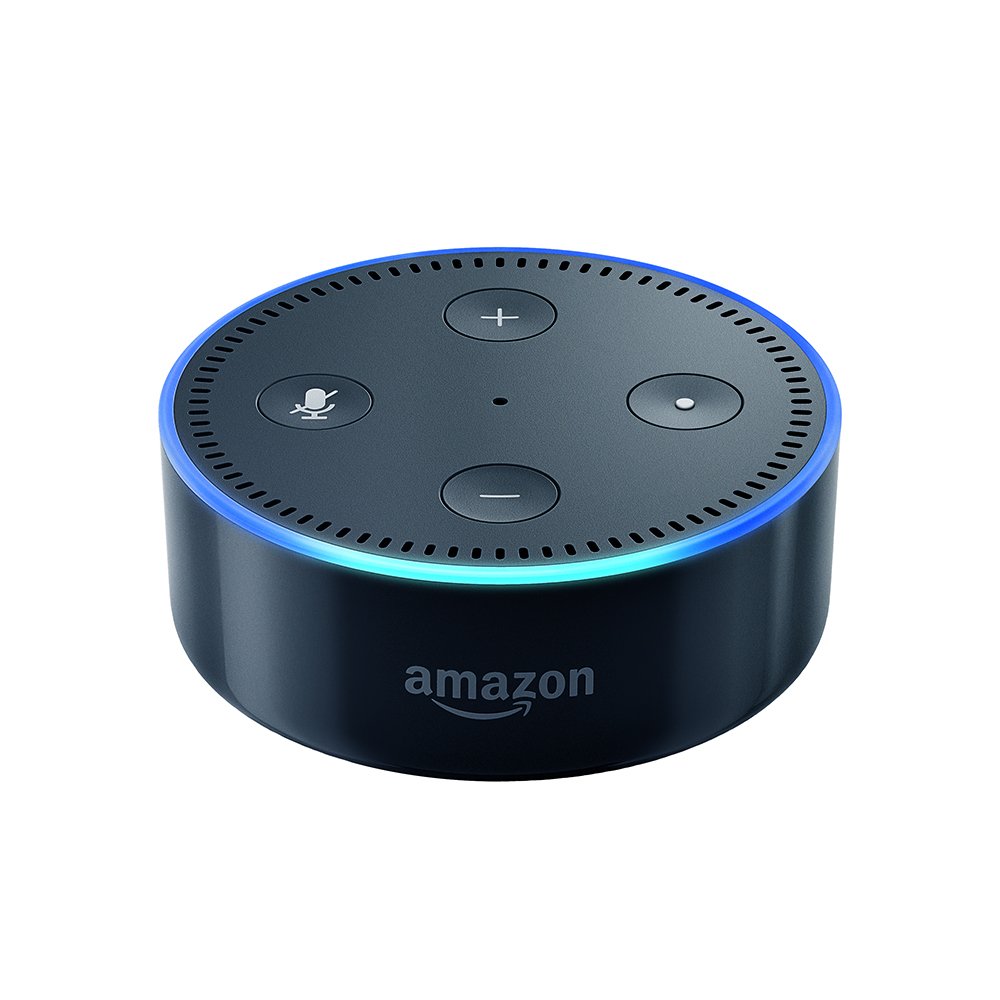
The Amazon Echo Dot (3rd Gen) is a big improvement over the original Dot (featured below). It’s nicer to look at and has upgraded audio that makes it easier to understand. And, you can even use the new Echo Dot for a bit of music or, more realistically, listening to radio.
This model still has the 3.5mm audio output and Bluetooth option, so you can connect it to a more powerful stereo. That feels like a slight waste of its capabilities, and if you want something to hook up to an existing stereo, the older Echo Dot is a cheaper option.
For use around your home, the new Echo Dot is a far better product than the older model, and its clearer audio improves the entire Alexa experience. Even better, it’s the same 

While the original Amazon Echo Plus felt like a bit of an odd product, with its smart home hub not giving the level of control we’d expect, the new model is an improvement. Now, with the Amazon Echo Plus (2nd Gen) you get a better overall experience.

First, the speaker has been redesigned and looks far nicer. Internally, Amazon has boosted the audio quality, and the new Echo Show is now the best-sounding Echo speaker. That’s particularly true if you use the speakers in a stereo pair, and if you then add in an Amazon Echo Sub subwoofer, too. With two Echo Shows and a Sub, you get a music experience that rivals other smart speakers.

Monday, December 17, 2018

Why Big Tech is breaking free of Silicon Valley


Looking for a new job in the tech industry? You might want to consider skipping the trip to Silicon Valley and heading to New York City. In a little more than a month, Amazon (AMZN), Apple (AAPL), and Google (GOOG, GOOGL)—three of the world’s biggest technology companies—have announced expansions within the Big Apple.
Google's announcement Monday calls for the company to spend more than $1 billion on capital improvements including the leasing or acquisition of three properties on Manhattan's West Side. In total, Google CFO Ruth Porat said in a blog post, the company will have enough new space to more than double its existing 7,000-person workforce in the city. The company's current headquarters are located in a massive building at West 15th Street and the Chelsea Market building next door.
Google's announcement, alongside Amazon's and Apple's, is proof that tech companies are making major moves outside of Silicon Valley and chasing workers across the country. Part of the reason for the move is to break free of the insular nature of Silicon Valley and draw new employees with unique ideas. Of course, moving into regions also gives them a foothold to guide policy and influence their new homes.
Bringing the jobs to the people
Throughout the explosive growth years of the tech industry, thousands of engineers, developers, and coders poured into Silicon Valley with the hopes of snagging a coveted position at one of the area's big-name tech firms.
Cities like New York, however, weren't resting while Silicon Valley scooped up all of those high-paying jobs. In September 2017, Cornell University officially opened its massive Cornell Tech campus on Roosevelt Island between Manhattan's East Side and the Queens neighborhood of Long Island City as part of the city's push to draw tech talent and jobs.
"Increasingly we're seeing tech companies looking for things that are uniquely available in large cities like New York," explained Julie Samuels, executive director of Tech:NYC, a New York-based industry group that seeks to attract tech jobs to the area. Samuels said wish list items companies are searching for in cities include universities, cultural and art institutions, public transportation, and diverse candidate pools.
"With an added 1.7 million square feet and capacity to double its local workforce, Google will increase its contributions to our community while shaping a larger shift in our local economy," Samuels said in a statement following Google's announcement.
"There can be no doubt that the tech sector will be leading the way for New York’s future—and between this move and Amazon’s HQ2 selection, it’s clear our city has the talent and ability to be the tech leader of the future.”
From east to west and in between
It's not just New York City that's benefiting from the growth in tech jobs outside of Silicon Valley. Austin, Texas; Portland, Oregon; Boston, Massachusetts, and Phoenix, Arizona have seen increased job opportunities from major tech companies. Such locations offer tech companies a way to attract employees who aren't so focused on life in the Valley.
"The Valley creates Valley think, and you're out of touch with real customers in the Valley," explained vice president and analyst at Forrester Research Ted Schadler.
It's not just about being able to attract talent and leaders from outside of Silicon Valley, though. By moving into cities beyond the region, Big Tech can spread its influence to a greater number of industries and institutions.
"They want to have local influence," Schadler explained. "They want to have influence over the communities and institutions in those locations. In New York they want to have influence over financial institutions and the media. In Washington they want to have influence over the government."
With more tech companies expanding outside of the valley, Big Tech will need to be wary of how it plots its expansion. As Amazon proved with the announcement of its HQ2 in Long Island City, Queens, not every neighborhood is willing to welcome these huge companies with open arms.

Thursday, May 14, 2015

Sonos update will make its cheapest speaker sound better


Sonos' whole-home audio systems can be pretty expensive, but the company is hoping to lure more people in with improvements to its entry-level speaker.

Sonos says its next firmware update will bring better clarity to the $199 Play:1 speaker, especially with vocals at high volumes. The update should also improve bass performance when the Play:1 is paired with Sonos' $699 subwoofer.

For those who are going all-in with home theater setups, Sonos is removing the Ethernet connection requirement for its Soundbar, Bridge, and Boost devices. This allows users to create 3.1 or 5.1 surround sound from multiple speakers using Wi-Fi only.

Sonos also says it's updating its developer tools to allow new features in the Sonos app. For instance, streaming music services could offer recommendations based on the time of day and other factors. Sonos is also testing some general interface tweaks and an improved shuffle feature.

The update is available now for Android beta users, and will roll out to all users this summer.

Why this matters: Although Sonos is seen as the leader in whole-home audio, it's starting to face some more competition. Both LG and Sony recently announced their own multi-room speaker lines, using Google Cast audio to stream music from smartphones and tablets. Entry-level speakers can serve as the gateway drug to the rest of the ecosystem, so it behooves Sonos to make its basic speaker sound a bit better.

Sonos Wireless Speakers


By Jared Newman

Tuesday, May 12, 2015

iPhone 6S release date, price, specs and new features: When is the iPhone 6s coming out? Will it be the iPhone 7?

It's 2015 and although the iPhone 6 and 6 Plus are still going strong it's time to look ahead to Apple's next flagship smartphone, which could be less than five months away. Here's what we know about the iPhone 6S release date, price and specs in the UK which might end up being the iPhone 7. Updated 11/5/15. Also see: Best new phones coming in 2015.

iPhone 6S: The name and models - will it be the iPhone 7?

Following Apple's history with smartphones, the next iPhone will be an 'S' model. However, there's always the possibility it will put an end to this tradition so we may be in store for the iPhone 7 this year – you just never know. In fact, reports suggest that the new iPhone is going to be so different from the current models that Apple will indeed skip to the iPhone 7. This is what KGI Securities analyst Ming-Chi Kuo thinks who has a proven track record of predicting Apple launches correctly.

For the last two launches, Apple has introduced two new iPhones. We currently have the iPhone 6 and the larger iPhone 6 Plus and previously Apple launched the iPhone 5S and iPhone 5C. Will we get two models again this year? We think so but rumours are thin on the ground on the subject at the moment but it's early days so stay tuned as we'll be updating this article as new information becomes available. Read: The best iPhone 6 alternatives.

iPhone 6S release date: When is the iPhone 6S coming out?

These days it relatively easy to predict when a new generation of a flagship smartphone will arrive. Most manufacturers announce a new model annually while some go for every six months.

Apple is one of the former and if we look at previous launches, it's highly likely that the iPhone 6S will be announced in September and will go on sale a week or two afterwards. Of course, if the launch event is towards the end of the month, the iPhone 6S release date could be early October. Bear in mind that if there are two new iPhones announced this year, they may not go on sale on the same day.

iPhone 6S: Design and specs

With an 'S' model iPhone, most things tend to stay the same in terms of design and specs. Usually there are a few tweaks here and there but Apple will save major changes for the next full model number – ie the iPhone 7.

It seems likely then that the iPhone 6S will look the same as the current iPhone 6. It will use the same chassis and come in the same colour options. The weight might change though due to different components inside or a new sapphire glass.

An S model sticks with the same screen size so we're probably looking at 4.7in and if there is an iPhone 6S Plus then it should remain at 5.5in. Resolutions are also likely to stay the same although one rumour suggests the new iPhone will have a 5in display with a 400ppi and what about the Samsung Galaxy Note Edge rivalling concept below by Michael Shanks?

So what will change?

If the design of the iPhone 6S remains the same, then Apple will provide upgrades in the form of new hardware. There are various rumours floating around, the most obvious of which, is of a new processor. The iPhone 6S will come with an A9 chip and could also get an upgrade in the RAM department to 2 GB.

The Touch ID fingerprint scanner could be integrated into the display, according to one rumour, rather than sitting in the home button. We thought the cameras would almost certainly be upgraded, although we're not sure a rumoured 21Mp rear camera is probable and analysts are now saying Apple will stick with 8Mp for the iPhone 6S.

More likely is a reversible USB connector. We already have the Lightning connector which can be plugged in either way round so we'd put money on Apple doing it at the other end of the cable, too. Also highly possible, practically a given, is that the iPhone 6S will come pre-loaded with iOS 9 which will probably be detailed at Apple's WWDC which normally takes place in June.

There's also a rumour suggesting that Apple may decide to use the same series 7000 aluminium that they use for the Apple Watch with the iPhone 6S. The Series 7000 aluminium is 60% stronger than standard aluminium, but keeps its lightweight form factor making it a great candidate for the iPhone 6S.

There are also reports from the WSJ that the iPhone 6S (possibly only the 6S Plus according to conflicting rumours) will support Force Touch. Currently built into the Apple Watch and the new 12inch MacBook, Force Touch gives the device pressure sensitivity, allowing them to distinguish between a light tap and a hard press, enabling opportunities for new gestures. The source is apparently an Apple supplier, so it's best to take this with a pinch of salt - Apple often tests technologies using suppliers that never make it into the final product, so this may also be the case with Force Touch.

One final rumour suggests that the iPhone 6S might be available in a rose gold colour in addition to the silver, gold and space grey, to match the rose gold Apple Watch Edition. Below is a concept image of a rose gold iPhone 6S by designer Martin Hajek.


By Chris Martin

Tuesday, March 10, 2015

Apple Just Tried to Address Its Gender Problem in the Worst Way Possible

Apple Just Tried to Address Its Gender Problem in the Worst Way Possible
(Via Reuters)
Did female Apple employees work to make the Apple Watch a possibility? 
Yes, obviously. Apple employs many women, including Senior Vice President Angela Ahrendts, who quit her job as CEO of Burberry torevamp Apple’s in-person and online retail experience in anticipation of this new luxurious wearable. By many accounts, Ahrendts has been instrumental in steering Apple’s watch strategy for the past two years. 
The casual viewer, however, would never know that Ahrendts, or any other woman, really, was part of the Apple Watch development process or launch. Because at its event on Monday, the company invited supermodel Christy Turlington on stage to talk about the project instead of any one of the women who were actually involved in its creation.
This wouldn’t be so bad if Apple’s track record with hiring, promoting, and showcasing its female employees were better. Lots of companies employ hot, famous people to sling their products to the masses, even if they have nothing to do with the creation of said product. 
But considering Apple’s storied history of live presentations, the fact that the company opted for a live appearance from Turlington, who took the stage instead of a smart lady executive who actually helped make the watch a reality, is a clear missed opportunity for the company to support a movement that so badly needs the public support of a corporate giant like Apple. 

The numbers

When it comes to hiring a balanced number of men versus women, Apple, like many of its peers in the tech industry, comes up short. Last year, as activists placed public pressure on tech companies to make their workforces more diverse, the company released statistics about the race and gender makeup of its workforce. A mere 30 percent of its 98,000 global employees are women. And the numbers get worse when you look at specific sectors. Only 28 percent of the company’s corporate leadership is female. And, disappointingly, women only make up 20 percent of its core tech sector.
image
Apple CEO Tim Cook admits that the company needs to do better. “I’m not satisfied with the numbers on this page,” he wrote in a letter that was released alongside the diversity report. “They’re not new to us, and we’ve been working hard for quite some time to improve them. We are making progress, and we’re committed to being as innovative in advancing diversity as we are in developing our products.” 
Since then, Apple has been working to change the makeup of its workforce, and how it’s perceived by women. Apple sent recruiters to a Women in Computing conference in Arizona. It continues to sponsor the National Center for Women and Information Technology. The company even announced it would cover the cost of freezing its female employees’ eggs. But at its public media events, Apple’s efforts have been uncomfortably nonexistent.
As the developer Joe Kukura found after watching 16 hours of past Worldwide Developers Conference event footage, Apple has shown only two live women on stage out of its 59 featured speakers since 2007. Neither were given major roles in the event. And neither were high-level executives. (As I mentioned, Apple doesn’t have many of those in the first place). Journalist Selena Larson confirmed this female scarcity with her own research, noting that “women or minorities have appeared a handful of times in photos while white male executives demonstrate the capabilities of the smartphone’s camera or editing software. They just weren’t on stage themselves.”

Tuesday, December 2, 2014

5 Cyber Monday Scams to Avoid

5 Cyber Monday Scams to Avoid(Thinkstock)
It’s the holidays, and everybody wants a piece of you.
“Cyber Monday,” the online counterpart to Black Friday, is not just a busy time for e-tailers. It’s also high season for scammers, who want a taste of the $2.6 billion online shoppers are expected to drop on the biggest online shopping day of the year.
Cyber con artists usually want one of three things: your money, your identity, or your computer. They aim to drain your bank account, use your online credentials to hide their tracks, and turn your computer into a tool they remotely control and rent out to other scammers.
The standard attack comes to you in a “phishing” email, a message that looks like it came from someone you trust, like your bank, employer, or a brand-name retailer. These emails are designed to lure you into opening a file attachment or visiting a website that steals your information or infects your computer. Phishing attacks can also come in online advertisements.
A recent study by brand protection firm Mark Monitor says one in six online consumers is duped into shopping at rogue sites. Another study shows that a quarter of all Facebook ads for luxury goods are for third-party knockoffs, like fake Rolex watches and faux Louis Vuitton bags.
The key component to these scams: you. You have to think that something bogus is the real deal and, just for a moment, treat it as such. Avoiding these scams isn’t particularly difficult. But if you’re not paying close attention (or you’ve had too much of Uncle Bob’s Southern Comfort eggnog) you could end up making a mistake that will cost you a lot, for a long time to come.
Here are five of the more common scams to watch out for:
1. Craaazy Cyber Monday specials.
Cyber Monday ad featuring 95% off an iPhone 5
OMG, $15 for an iPhone 5 and $76 for an iPad? I’ll take half a dozen of each! (McAfee)

Some crazy Cyber Monday deals are a little too crazy, which is why anything advertising brand-name electronics at bargain-basement prices should be greeted with extreme skepticism. But greed — or unbridled optimism — often tempts you to click anyway. What happens next?
One scenario is that the ad leads you to a website that wants to steal your information or infect your computer. It could be a bait and switch: That super-cheap iPad is suspiciously out of stock, replaced by models with a heftier price tag; or the price doesn’t include extra-cost “accessories” (like a power supply, memory, or a manual). The goods might be customer returns or refurbished models being sold as new. They could be third-party knockoffs or counterfeit items. Or the site could simply take your credit card information and then vanish.
CR: Dan Tynan, Tech Columnist @yahoo.com

4 Ways to Take Better Care of Your Laptop’s Batteries

4 Ways to Take Better Care of Your Laptop’s Batteries
You likely spend more time on your laptop than with your significant other, your dog or — at the very least — your plants. So there’s no reason you shouldn’t treat it with the same tender loving care. Here are a few tips to ensure that your gadget’s battery has a long and happy life. 
(This guide is focused on lithium-ion batteries, which is what most modern laptops are packing. If you want to learn about how to care for other types of batteries, check out Battery University, a dense database of such things.)
1. Don’t get too attached.
When you plug your laptop in for the first time, you should make sure to fully charge it once to calibrate it. But after that, aim to keep it between 40 and 80 percent. Apple’s customer care says you should do this to “keep the electrons in it moving occasionally.” Wired has a better explanation of whyhere. But the bottom line is, doing this can help prolong your battery life by as much as four times. 
I know that’s easier said than done. Just remember to keep an eye on your battery percentage (usually shown in a corner of your screen) throughout the day. If you leave your laptop at home, then shut it down, close it and keep it unplugged on a desk, not a couch. 
You should also fully charge and discharge your computer’s battery at least once a month. Set a reminder on your phone or something. You forked over what I assume to be a ton of money for this thing, so paying attention to it once a month shouldn’t be a problem.
2. Stay cool.
Most modern laptops are made with lithium-based batteries, which should be stored in temperatures between 50 and 95 degrees Fahrenheit. You might not always be able to keep tabs on that sweet spot, so to make things a bit simpler, room temperature is fine. 
That being said, there are a few ways you can make sure your laptop isn’t constantly having menopausal hot flashes. You should start by minding its air vents. Most MacBook vents are located on the back of the laptop, near the top of the computer. Whenever you prop your laptop up on your bed, couch or lap, you’re likely blocking the airflow. This, in turn, causes the computer to overheat. And overheating will screw up your battery life. 
image

Courtesy of Macinfo
That’s not to say you should be completely paranoid about keeping it on flat, cool surfaces all the time. But maybe consider moving it to a desk before you fall asleep or head to work.
3. Update, update, update.
Most companies are constantly looking for ways to improve battery life via software updates. In fact, it was one of the main things Apple touted in its OS X Mavericks release last year. You may fear change, but change can extend your battery life. So make sure you have the latest software installed on your computer.
4. Don’t just leave it there.
Maybe you’re in trouble with the law and need to disappear for six months. We understand how these things go. But that doesn’t mean you’re off the hook for correctly storing your computer. You should store it with a 50 percent charge in a consistently cool area. Storing the computer with a fully discharged battery might ruin the battery forever. And storing it with an absolutely full charge might cut the battery’s lifespan short.
Simple enough? Now go, be a better laptop owner. Your machine is counting on you.
CR: Alyssa Bereznak, Tech Columnist @yahoo.com

Monday, December 1, 2014

MIT engineers have high hopes for cheetah robot

CAMBRIDGE, Mass. (AP) — It's a robot unlike any other: inspired by the world's fastest land animal, controlled by video game technology and packing nifty sensors — including one used to maneuver drones, satellites and ballistic missiles.
The robot, called the cheetah, can run on batteries at speeds of more than 10 mph, jump about 16 inches high, land safely and continue galloping for at least 15 minutes — all while using less power than a microwave oven.
It's the creation of researchers at the Massachusetts of Technology, who had to design key elements from scratch because of a lack of or shortcomings in existing technology.
That includes powerful, lightweight motors; electronics that control power for its 12 motors; and an algorithm that determines the amount of force a leg should exert during the split second that it spends on the ground while running — the key to helping the robot maintain balance and forward momentum. An onboard computer organizes data from various sensors and sends commands to each motor.
"This is kind of a Ferrari in the robotics world, like, we have to put all the expensive components and make it really that instinctive," said MIT Professor Sangbae Kim, who heads the school's Biomimetic Robotics Lab that designed the robot. "That's the only way to get that speed."
Insight gleaned from the design of their prototype could have real-world applications, including the design of revolutionary prosthetics, wearable technologies, all-terrain wheelchairs and vehicles that can travel efficiently in rough terrain much like animals do, Kim said. There are hopes the robot will be able to be used in search and rescue operations in hazardous or hostile environments where it's too risky to send a human rescuer.
"When the robot is running, at every step, we calculate the appropriate amount of the force to the legs so that the robot can balance itself," said MIT research scientist Hae-Won Park, who wrote the complex algorithm used to control the cheetah, which weighs around 70 pounds — about the same as one of its female feline counterparts.
Sensors inside the robot measure the angle of the leg and that information is sent to an onboard computer that also organizes data from the Inertial Measurement Unit, or IMU, which is also used to maneuver drones and ballistic missiles, Park said.
The project is funded by the U.S. Department of Defense's Defense Advanced Research Projects Agency. The military research arm is also funding a similar robot being developed by Boston Dynamics. The company says its version is powered by an off-board hydraulic pump and uses a boom-like device to keep it running in the center of the treadmill.
Crafting the cheetah robot took five years of designing, testing, tweaking and plenty of confidence to ignore those who said electric motors aren't strong enough to propel a running mechanical cheetah powered by batteries.
Researchers had to exercise a lot of patience during test runs. The robot broke dozens of legs manufactured by 3-D printers and reinforced with Kevlar strips and carbon fiber.
The results?
Strong, lightweight components that made untethered running possible, including a carbon fiber-and-foam sandwich frame that can absorb the forces generated by running and jumping.
Some off-the-shelf components, including an Xbox controller for maneuvering the robot and wireless Internet communications for sending commands to the mechanical cheetah, also came in handy.
Each leg is propelled by three motors that can generate powerful forces at slow speeds.
Still, researchers continue to tweak their prototype, looking to add additional sensors that would eventually make the robot autonomous.
"In the next 10 years, our goal is we are trying to make this robot to save a life," Kim said.
CR: yahoo.com

Collisions Between Drones And Airplanes Serious Concern, ‘Enforcing Regulations Difficult’ FAA Warns

Drone collision with airplane possible
The Federal Aviation Administration is warning drone hobbyists to heed regulations in order to prevent collisions between drones and airplanes.
According to CNN, Michael Huerta, head of the Federal Aviation Administration, notes that regulations are in place to prevent drones from interfering with large aircraft. However, not all drone operators are following the guidelines set forth by the FAA. The FAA hopes to increase education and enforcement of the laws that they feel are necessary to keep drones from interfering with airplane flights.
WTMA reports that the FAA is concerned about safety, as the number of cases involving aircraft and drones is increasing. Since February of this year, nearly 25 airplanes have had to change course due to near collisions with unmanned drones. Altogether, there were about 200 incidents involving drones since February, including the 25 that caused a diverting of course. Huerta said the concern is serious.
“That is certainly a serious concern and it is something that I am concerned about.”
As it stands now, FAA regulations prohibit operators from flying drones higher than 400 feet, near an airport, or out of eyesight. However, enforcing these regulations has proven difficult. Aside from identifying drone flyers not operating within the FAA’s rules, many drone operators may not be educated on proper use. Therefore, the FAA wants to spend more time educating the drone hobbyist community on how to safely fly a drone, not just prosecuting those who disregard regulations.
“We have been working with the Model Aeronautics Association, with the model community and clubs so we can educate people because these are not your typical pilots that may be flying one of these for the first time and they may be unfamiliar with the rules.”
Some drone proponents, however, would like to see free and open use of drones.
“Yes, there are proponents of unmanned aircraft and they really see huge potential with this technology and for them, we can’t move fast enough,” Huerta said. “What they would like to see is free and open use of unmanned aircraft as soon as we can get there.”
Huerta says that he understands their enthusiasm towards drone use, but wants them to consider the airplane pilots prospective. Drones are small and difficult to see for pilots. This means that a collision can be very difficult to avoid when a pilot does not know a drone is in the area or flight path. The FAA is looking at ways to appease both the airplane community, as well as drone operators. One suggestion is to find a way to certify the drone aircraft and operator.
“I can’t say what is going to be in it but broadly speaking, what we are looking at are all the questions relating to how we certify the aircraft and what are the qualifications of the operator as well as what uses they can be put to.”
What do you think of the FAA’s concerns regarding drones and standard airplane traffic? Does the FAA have a right to limit the use of drones to 400 feet?
CR: inquisitr.com

Sony Hackers Steal DVD Rips? Torrents Appear After Hack

Did the Sony hackers steal DVD rips of unreleased movies? Less than a week ago, Sony Pictures was hacked. The hacking came with a massive Twitter takeover, involving perhaps more than two dozen of Sony’s accounts. The hack also came with a warning. If Sony didn’t comply with certain demands (these were never made public, and Sony claims to have never heard the list either), data would be released.
For a bit over an hour, several Sony accounts bore the image above, then the company regained access and was able to delete the tweets.
Sony Hackers Steal DVD Rips? Torrents Appear After Hack image sony hackers steal dvd rips part 2
Security Week reports that the attack may have been by a North Korean hacker group known as Guardians of Peace, or #GOP. Here again, there’s nothing solid to confirm the fact, but Security Week shared some speculation about the motivation behind the attack:
“The Interview,” which stars Seth Rogen and James Franco as two journalists recruited by the CIA to bump off Kim, has infuriated the North Koreans, with state media warning of “merciless retaliation.”
So, did Sony’s hackers steal DVD rips while they were in the system leaving their message? Looks like there’s no one who can resist a good movie.

CR: yahoo.com

Monday, May 19, 2014

Can Video Games Teach Your Child to Be a Better Person?

One day about four years ago, I came home from work and heard utter mayhem coming from my son’s room: Russian voices, screeching tires, gunshots. I bolted up the stairs and threw open his door.
I found him parked in front of his Xbox, playing Grand Theft Auto IV. I watched his avatar lead police on a high-speed chase through the absurdly empty streets of Liberty City. He crashed a car into a light pole, hopped out of his car, and began emptying a .45 Magnum at the cops.
Can Video Games Teach Your Child to Be a Better Person?
(Thinkstock)
This game was most definitely not on the family approved-to-play list. My first instinct was to grab the Xbox and throw it out the window. My wife persuaded me to conserve my moral outrage for those moments when he did something dangerous or stupid in the real world, not in a virtual one.
Still, for a little while I felt like the world’s worst parent. Then I sat down and watched him play, and I also watched the story on the Xbox unfold before him. I realized that GTA is a dystopian satire not all that different from movies like A Clockwork Orange, which thoroughly outraged parents when I was his age. 
The idea that playing video games makes kids violent and antisocial is often accepted as a sobering fact of modern life. Whether it’s true is less clear — some studies say yesothers say nyet. In the real world, watching Clockwork did not make me into a droogie. And playing GTAdid not turn my son into a murderous thug. He’s a great kid.
But let’s assume the fear has some truth, that violent media contributes to violent behavior. If so — if games teach kids to shoot first and to drive as if cars are weapons — can’t games also be used to impart positive life skills like empathy or compassion? Can video games boost a child’s emotional quotient (EQ)?
Some people think they can. One of them is Trip Hawkins, founder of Electronic Arts, most famous for creating the most popular sports simulation game of all time, John Madden Football. Now he’s trying to prove it via a fantasy adventure game called IF… aimed at tweens.
You the dog, manJust as Madden Football is based on actual NFL playbooks, IF… is based on decades of research in social emotional learning (SEL). The game takes place in a land called Greenberry populated by dogs, cats, and magical Pokemon-like characters known as Vim. Long ago, the dogs and cats were driven apart by conflict, and Greenberry fell into ruin.
Guided by the Yoda-like YouDog, players must learn how to tame the Vim, resolve the conflicts, and bring Greenberry back to harmony. Along the way they’re presented with questions and a choice of answers measuring their degree of empathy and other SEL attributes.
image
You’ve got three choices. Pick the wrong answer, and you’ll get a lesson in sensitivity from YouDog.
Each chapter teaches 20 distinct SEL skills, such as listening, managing emotions, or expressing gratitude. As each chapter is completed, parents get a report detailing how well their child did. The first chapter of the book-like adventure is available for free in the iTunes Store. New chapters will start to become available in June for around $5 apiece.
To be frank, this is not the most exciting game your child will ever play. The first chapter is didactic, slow, and unlikely to lure anyone away fromMinecraft, Runescape, or Club Penguin. (I’m told things get livelier in Chapter 2.) But Hawkins says the rewards are more subtle and long lasting.
“This game is not about advancing in levels; it’s about teaching compassion,” he said. “You’re like the Jimmy Stewart character in It’s a Wonderful Life. You see how the town ends up in tatters without you, and it’s up to you to make it right.”
Learning to copeThough IF… is probably the most ambitious and well-funded attempt to employ gaming techniques to teach kids emotional skills, it’s not the only one. The Social Express uses Pixar-like animation to teach kids age 5 and up how to read emotional clues and react to them appropriately.
image
The Social Express starts by teaching kids how to recognize their own emotions, and then how to apply coping skills.
Rather than embed lessons inside the plot of a role-playing game, The Social Express uses brief webisodes that target specific situations and model appropriate behavior, CEO Marc Zimmerman says.
Kids can apply those lessons to their own lives via a 99 cent Android or iOS app called My Digital Problem Solver. My DPS lets kids choose an image that shows how they feel at the moment (frustrated, scared, mad, or whatever) and then select a coping strategy like taking deep breaths or “positive self talk” to calm down.
In use by more than 100 school districts across the country, The Social Express is also available to families for $5 a month per child. Parents can track their child’s progress through the lessons via a free mobile app.
IF….. and The Social Express are two examples of a small but growing genre of digital works that explore emotions besides fear and anger, which tend to dominate most video games, said Tanner Higgin, senior manager for education content at Common Sense Media.
“There’s a wide range of feelings like loneliness, trepidation, and guilt that have remained largely untapped,” he said. “Over the last few years we’ve started to see a lot more games that implicitly or explicitly build social skills and expand the emotional spectrum.”
The play’s the thingRespecting other people’s feelings, sharing, being empathetic — aren’t these things kids should be learning from their parents, not from a screen? I asked Janice Toben, founder of the Institute for Social and Emotional Learning, who consulted on the curriculum baked into IF… .
Yes, she replied. But she added that many parents lack the ability to model those traits themselves, especially during emotionally charged encounters with their children. So, for example, instead of calmly explaining that a violent video game is detrimental to a child’s emotional development, they are instead tempted to rip the cables from the Xbox and hurl it into the street. 
“Parents want to be able to create a common vocabulary around things like calming down, listening to each other, and getting along, but not everyone knows how to do it,” she said. “I think a game like IF… can help, if the parents are interested and involved.”
Research has shown that playing games can sharpen a child’s problem-solving skills (not to mention his aim and his reflexes). If games can boost his IQ, why not his EQ? At the very least it’s worth a shot — metaphorically speaking, of course.
CR: yahoo.com